The Notes Conversion Problem (And Why 97% of Writers Get It Wrong)
Welcome to the Notes conversion problem. And you’re not alone, 97% of writers using Notes are stuck in the same trap.

Let’s talk about the number everyone’s chasing, but nobody’s hitting: subscriber conversion from Notes.
You’ve heard the success stories. Writers gaining 6,000 subscribers in six months from Notes. Others report Notes driving 60% of their new free subscribers. The platform itself shows Notes as the top source for subscriber growth.
So you start posting. Daily Notes. Multiple times per day. Engaging in comments. Restacking other people’s work. Following all the advice.
Three months later, you’ve added 500 new subscribers from Notes. Feels good, right?
Then you check your open rates. They’ve tanked. Your paid conversion rate? Stuck at 2% when Substack says the average is 5-10%.
Welcome to the Notes conversion problem. And you’re not alone 97% of writers using Notes are stuck in the same trap.
📌Before we continue - If this post gave you any value, it would mean a lot if you restack it with your audience.
The Data Nobody Wants to Talk About
Here’s what actually happens when you grow through Notes:
The average paid subscriber conversion rate on Substack is 3%.
Not the 5-10% the platform advertises.
That’s across 20% of publications analyzed. The other 80% is converting at even lower rates.
But here’s where it gets interesting:
Subscribers who come from Notes have significantly lower intent than subscribers who find you through other channels.
Think about it. Someone reading your article on Reddit, clicking through to your profile, navigating to your Substack, and then subscribing? High intent. They wanted to find you.
Someone scrolling Notes, seeing your post, clicking Subscribe with one tap because they’re already logged in. See, it’s low intent. They’re already subscribed to 20-50 newsletters, and yours just became number 51.
One writer with 92K subscribers and 1.9K paid subscribers put it bluntly:
Notes can generate a lot of free subscribers, but the quality of those subscriptions is much lower. Most of those readers just clicked ‘Follow’ without the intention to subscribe.
The math is brutal. You can spend months building a massive free subscriber list through Notes and still struggle to monetize because you’re collecting the wrong kind of subscribers.
Why Notes Growth Feels Like Running on a Treadmill
Let me paint a picture of what’s happening:
You post a Note. It gets good engagement. You gain 50 new subscribers that day. Dopamine hit. You feel like you’re winning.
But behind the scenes:
30 of those subscribers are already subscribed to 40+ newsletters
15 won’t open your first email
4 will open once and never again
1 might actually become an engaged reader
Your subscriber count goes up. Your engagement rate goes down. Your paid conversion stays flat.
This is why so many writers report growth slowdowns after initial Note success. They’re not doing anything wrong; they’re just filling their list with people who were never going to pay attention anyway.
One writer tracked this exact pattern:
Substack App (where Notes is included) is the number one contributor for my paid subscriptions. But I have 924 imported emails and most are external to Substack. The average conversion rate from those is Around 3%, a lot lower than Substack average.
The subscribers coming from Notes convert just at dramatically lower rates than engaged readers from other sources.
The Time Problem Everyone Ignores
Now I am going to tell you something most people ignore: the time investment required to make Notes work.
The successful creators on Notes aren’t posting once a day. They’re posting 2-3 times daily. They’re engaging in comment sections. They’re restacking. They’re DMing other creators.
That’s 1-2 hours per day. Minimum.
For what? To gain subscribers who might convert at 2-3% instead of 5-10%.
The math doesn’t math.
Let’s say you spend 10 hours per week on Notes. You gain 100 new subscribers per month. At a 3% conversion rate and $5/month subscriptions, that’s 3 paid subscribers. $15/month.
Your hourly rate? $0.38.
You could work a minimum wage job and earn 19x more money in the same time.
But it’s about building long-term! Sure. But if you’re spending 40+ hours per month on a channel that converts poorly, you’re not building efficiently; you’re just staying busy.
What Actually Converts (The Strategy They’re Not Teaching You)
Here’s where this gets interesting. Notes do work for some creators. Just not the way most people use them.
One creator found that:
While a great newsletter post might bring in 20-30 new subscribers, a strategic Note can do the same with 1/10th the effort.
Strategic. That’s the word that matters.
The creators winning with Notes aren’t posting random thoughts 3x daily. They’re using Notes as a targeted top-of-funnel tool with a clear conversion path.
Here’s what that actually looks like:
They target high-intent topics. Not here’s what I’m thinking about today Notes. Specific value bombs that solve specific problems for specific people.
They optimize their subscription page obsessively. As one bestselling writer put it: Your subscription page is the one single place where your subscribers have to choose whether to become paid or stay free. There’s a science to it.
They track conversion by source. They know exactly which Notes drive subscribers who actually convert. Then they do more of that and less of everything else.
They use Notes to build relationships with other creators. Not mass engagement. Targeted connections with writers who have overlapping audiences and similar conversion rates.
This isn’t a post daily and hope. It’s strategic content distribution with clear measurement and optimization.
The Tool Problem (And Why Manual Posting is Killing Your Conversion)
The problem most writers don’t even realize they have: posting at the wrong times.
Your best subscribers are not online at 11 PM when you finally sit down to write your Note after finishing your newsletter. They’re scrolling Notes during their commute, over lunch, or in the evening.
But you’re posting whenever you remember. Which means you’re missing your highest-intent audience entirely.
This is where scheduling becomes critical. Not just for consistency for conversion optimization.
One software developer couldn’t post during business hours but wanted to reach his audience when they were most active. After using a scheduling tool, his engagement and conversion improved because he was showing up when his readers were actually paying attention.
The timing isn’t just about visibility. You have to catch people when they’re in decision mode, when they’re actually ready to subscribe and engage.
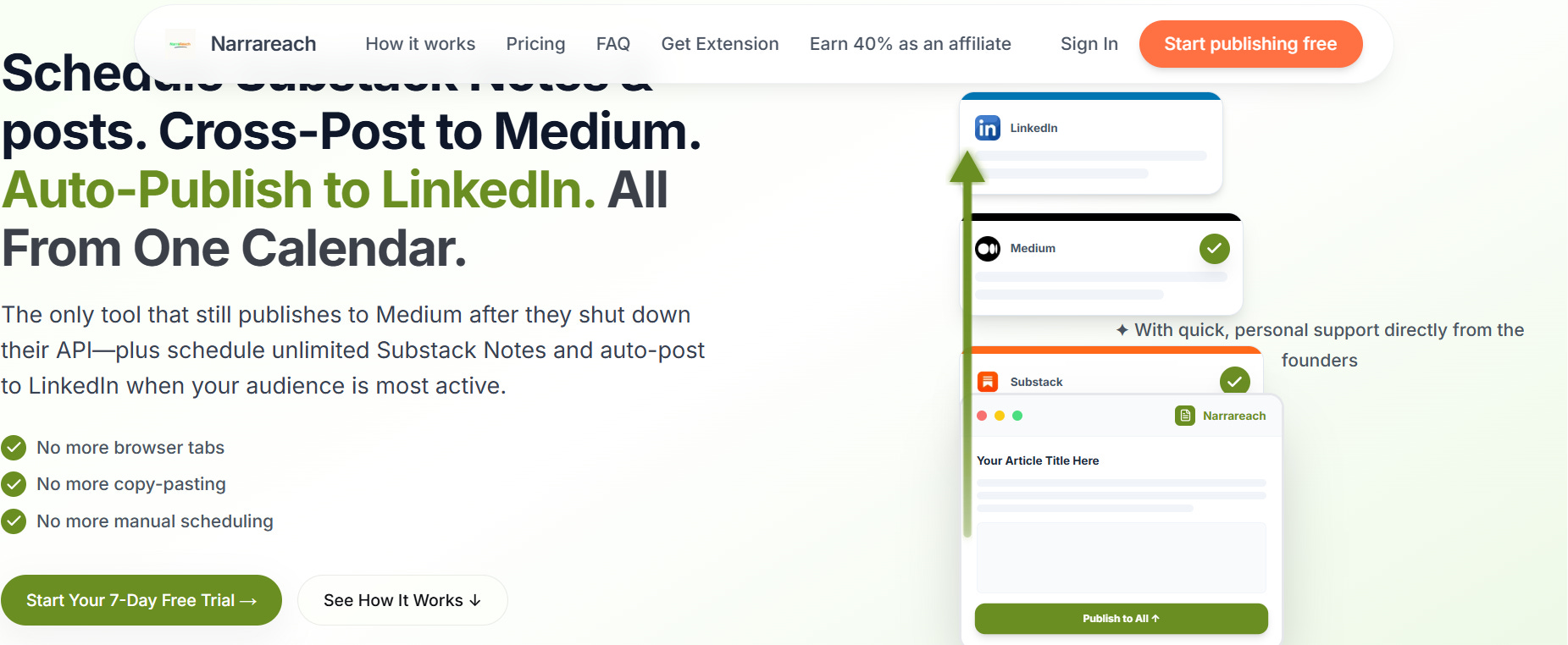
NarraReach solves this exact problem. It’s built specifically for writers who understand that consistency beats intensity, and strategic timing beats random posting.
Narra Reach lets you write once and schedule for optimal posting times across multiple platforms, Substack Notes, LinkedIn, and Medium, all from one place.
You write in one sitting, schedule for the week, and the tool handles distribution when your audience is most active.
But here’s the part that matters for conversion: it preserves your paywalls and free-to-paid funnels across all platforms. You’re not just spraying content everywhere, you’re building intentional conversion paths that stay intact wherever readers find you.
The difference between posting manually and using strategic scheduling is very clear.
One creator reported going from sporadic engagement to shipping 3-5 cross-posted pieces per week without context switching, staying top of feed on Medium, Substack, and LinkedIn simultaneously.
That’s not just about being visible. It’s about being consistently visible to the right people at the right times, which is what actually drives conversion.
The Audience Quality Problem
Let’s get uncomfortably honest about something: not all subscribers are created equal.
You can have 10,000 subscribers and make $500/month. Or you can have 1,000 subscribers and make $5,000/month.
The difference? Audience quality.
Someone who subscribes to the Notes feed has less intent than someone who reads something you posted on Reddit, navigates to your Reddit profile, clicks the link to your publication, and then subscribes.
This is why one bestselling writer tracks conversion rate by channel and found:
I have 924 imported emails. Most of those people are external to Substack, and they read my content only via email. The average conversion rate you can expect from such an audience is around 3% a lot lower than the Substack average.
The platform makes it easy to grow. Too easy. And easy growth means low-intent subscribers.
So what do you do about it?
Option 1: Accept lower conversion rates and optimize for volume. This works if you’re willing to build to 50K-100K subscribers, knowing only 2-3% will ever pay. It’s a valid strategy, it’s just a long grind.
Option 2: Optimize for intent from day one. Use Notes strategically to attract high-intent readers, not just anyone who’ll click subscribe. This means fewer total subscribers but dramatically higher conversion rates.
Most creators try to split the difference and end up with neither volume nor quality.
The Real Strategy (That Actually Builds Revenue)
Here’s what works in 2025, based on creators who are actually making money:
Step 1: Define your high-intent subscriber. Not writers or entrepreneurs. Specific. “Product managers at Series A startups trying to navigate stakeholder management.” That's specific.
Step 2: Use Notes to provide micro-value to that exact person. Not random thoughts. Specific insights they can’t get anywhere else. The highest-performing Notes provide insights, tips, or observations instead of promotional content about newsletters.
Step 3: Make your subscription page convert. There’s a science to it. Don’t go random. Your free posts need to prove value. Your paid posts need to create urgency. Your subscription page needs to close the deal.
Step 4: Track everything by source. Use your Substack stats to see exactly where your paid subscribers come from. Double down on those channels. Cut the rest.
Step 5: Build relationships, not just reach. Notes that encouraged thoughtful comment discussions generated more subscribers than those with just high likes. Engagement beats vanity metrics every time.
Step 6: Use scheduling tools to stay consistent without burning out. You can’t optimize what you’re not consistently doing. Tools like Narra Reach let you batch-create content and distribute it strategically without living on the platform.
This isn’t about posting more. It’s about posting smarter.
The Time Reality
Let’s talk about timelines because the 6 months to 10K subscribers crowd is lying to you.
To earn $500 per month from Substack subscriptions, you need roughly 2,500 free subscribers with a 4% conversion rate at $5 per month. For most people, it will take one to two years or more.
One to two years. Not months. Years.
And that’s with decent conversion rates. If you’re growing through Notes without optimizing for quality, you might need 5,000-10,000 subscribers to hit that same revenue.
But here’s the good news: you can compress that timeline dramatically by focusing on conversion from day one instead of chasing vanity metrics.
One creator went from 2% to 5.7% total conversion rate and from 4.8% to 8.3% in organic channels. That’s double. Same effort. Better strategy.
The difference between a 3% and 6% conversion rate isn’t just twice the revenue, it’s half the time to profitability.
What This Means for Your Next 90 Days
You have two options:
Option A: Keep doing what everyone else is doing. Post Notes daily. Engage randomly. Hope for growth. Watch your subscriber count climb while your conversion rate stays flat. Burn out in 6-12 months and wonder why Substack doesn’t work.
Option B: Get strategic. Define your high-intent reader. Create value specifically for them. Optimize your subscription page. Use scheduling tools to stay consistent. Track conversion by source. Adjust based on data.
Option B takes the same amount of time. It just produces radically different results.
The writers making real money on Substack are smart. They figured this out 18 months ago. They’re not posting more than you. They’re posting smarter.
The Missing Piece (That Changes Everything)
Here’s what most newsletter growth advice misses: strategy without support is just theory.
You can read articles about optimizing conversion. You can study successful creators. You can try to reverse-engineer their approach.
Or you can learn directly from people who’ve already figured it out.
That’s why I built GrowStack, a paid community specifically for newsletter creators who want to actually grow, not just stay busy.
Inside GrowStack, we cover:
Exactly what to post in Notes (with templates and examples)
How to write content that converts free subscribers to paid
Monetization strategies beyond subscriptions
The specific metrics to track and optimize
Weekly strategy sessions with creators who are ahead of you
This isn’t another how to grow on Substack course. It’s a working group of people implementing real strategies and sharing actual results.
If you’re tired of generic advice and want specific, actionable tactics that work in 2025, join GrowStack here.
Substack IS Social Media (But Not The One You Signed Up For)

Join Substack’s biggest creator community Today & Grow Your Writing Influence.
The Bottom Line
Notes work. But not the way most people use them.
97% of writers treat Notes like Twitter, posting random thoughts, hoping for engagement, and wondering why conversion stays flat.
The 3% who actually make money? They understand that Notes are a top-of-funnel tool in a larger conversion system.
They post strategically. They optimize ruthlessly. They use tools to stay consistent without burning out. And they track everything.
You can keep chasing subscriber counts that don’t convert. Or you can start building an audience that actually pays.
The strategy is simple. The execution takes work. But the difference between where you are and where you want to be? It’s not more effort. It’s a smarter effort.
Start today. Track your conversion by source. Optimize your subscription page. Use scheduling tools to stay consistent. Join communities that share real data.
Do this for 90 days, and your newsletter will look completely different.
Not because you worked harder. Because you finally worked smart.
Sources & Tools:
What Is The Average Paid Subscriber Conversion Rate on Substack? - Real conversion data from multiple publications
$156,960 Per Year From Substack: Steal This Strategy - Case study on Notes strategy
Write2Sell: Increase Your Free to Paid Conversion - Data-driven conversion optimization
How Substack Is Remarkably Changing The Game - Platform statistics and trends
Narra Reach - Multi-platform scheduling tool for newsletters
7 Underestimated Substack Features - Timeline and monetization data
The Secret Weapon: Substack Scheduled Notes Tool - Scheduling strategy insights
Until next time, keep writing, keep testing…and keep promoting.
Upgrade to paid and get full access to my platform economy articles, ghostwriting and growth strategies, mini-challenges, ebooks, and live sessions that actually teach you how to grow your audience, build your business.