
Why Your Substack Isn't Growing.
Most writers think consistency is enough. It's not. Here's what you're missing.


This is a SparkLoop affiliate link. I earn a small commission if you sign up.
Remember when Substack first exploded?
Back in 2019-2020, writers were joining the platform and watching their subscriber counts climb with what felt like zero effort. Bill Bishop launched his China newsletter and hit six figures in revenue almost immediately. Matt Taibbi left Rolling Stone and built a massive paying audience within months. Stories were everywhere about journalists leaving traditional media and building audiences of thousands within months.
Post once a week, have a decent topic, and subscribers would just... appear.
Fast forward to today.
You’re staring at your dashboard at 11 PM on a Tuesday. You’ve been publishing for six months. Maybe a year. You’re consistent. You hit publish every week, sometimes twice. You pour your heart into every piece. You’re doing everything the grow your newsletter threads tell you to do.
And you’re still sitting at 47 subscribers. Or 200. Or maybe you hit 1,000 but can’t break past it no matter what you try.
Meanwhile, you’re watching other writers writers who started AFTER you blow past 2,000, 5,000, 10,000 subscribers. And you’re wondering what you’re doing wrong.
What changed?
Everything. And nothing.
I’ll tell you what you’re doing wrong: you’re playing a game that doesn’t exist anymore.
And the worst part? You probably know it. You just keep doing it anyway because someone told you consistency is key and you’re hoping if you just show up enough times, eventually it’ll click.
The Game Changed. You Didn’t.
Substack now has over 5 million paid subscriptions and 35 million active readers, with more than 50,000 writers earning money on the platform. The early days of build it and they will come are dead and buried.
But most writers still playing by the 2019 playbook.
They think showing up is enough. They think good writing automatically finds an audience. They think if they just keep publishing, keep being consistent, keep adding value, eventually the subscribers will come.
That’s not how this works anymore. And honestly, It never really worked that way.
Those early writers who grew fast weren’t just writing. They were in the recommendation networks. They had existing audiences from Twitter or their old jobs. They knew people.
You don’t have that. So you need to do something different.
The writers growing now, going from 500 to 5,000, from 2,000 to 20,000 → they’re not just writing and hoping. They’re not sitting around waiting for someone to discover their genius mind. They’re not waiting for the algorithm gods to smile upon them.
They’re doing the work everyone else thinks is beneath them.
📌Before we continue - If this post gave you any value, it would mean a lot if you restack it with your audience.
Problem #1: You’re Publishing Into the Void (And Wondering Why Nobody’s Listening)
Let’s be real about what you’re doing right now.
You write your post. You edit it. You find the perfect image. You spend 20 minutes on the subject line. You hit publish. You share it once on Twitter or LinkedIn. Maybe you post it in Notes.
Then you wait.
And nothing happens. Maybe 3 people open it. Maybe 12. Your most engaged reader is your mom.
You tell yourself it’s fine. You’re building an archive. You’re playing the long game.
But really? You’re just throwing words into the void and hoping someone swims by.
Here’s what you’re missing: your content needs people to actually see it.
I know, revolutionary concept.
The writers growing right now aren’t precious about their content. They’re active on Notes every single day. They’re commenting on other newsletters not just dropping “great post!” but actually engaging. They’re in the recommendation feeds. They’re treating Substack like the social platform it is, not just an email delivery service.
One writer I worked with tracked where her subscribers came from over 90 days. Want to guess how many came from her brilliant writing sitting in someone’s inbox?
Zero.
Every single new subscriber came from three places: Substack Notes, LinkedIn posts, and Recommendations from other writers. Her content wasn’t the problem. Nobody knew it existed.
You can write the best newsletter in your niche. But if you’re invisible, you’re just practicing in private.
I posted something on Notes last week: Your articles are useless if nobody reads them. So please promote your work.
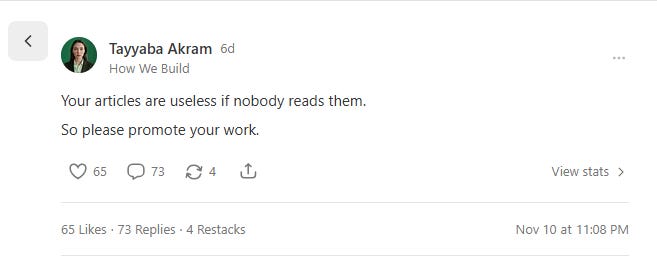
And oh man, did that hit a nerve.
Someone replied saying writing can never be useless, it’s art. Another person said my writing isn’t useless just because it doesn’t have readers yet. Someone else jumped in with real writers write for themselves first.
Look, I get it. Nobody wants to hear that their carefully crafted 2,000-word essay that took them 6 hours to write is useless.
But let’s me tell you what’s happening here. You’re not writing for yourself. If you were writing for yourself, you’d keep a journal. You’re publishing on Substack because you want people to read it. You want subscribers. You want engagement. You want to build something.
And if nobody’s reading it? Then yeah, it’s not doing what you need it to do.
Problem #2: You’re Trying to Feed Everyone at Thanksgiving Dinner
I see this constantly and it drives me insane.
Writers who think their newsletter is about personal development or business insights or life lessons and things I’m learning.
That’s not a niche. That’s everything and nothing at the same time.
You’re trying to write for everyone. A little career advice here, some productivity tips there, maybe a personal story about your weekend, book recommendations, a recipe you tried, thoughts on the news.
Nobody subscribes to that. You know why?
Because I can find 500 other newsletters doing the exact same thing. And at least 50 of them have been doing it longer than you with bigger audiences and better distribution.
You’re cooking with every ingredient in the grocery store and wondering why nobody wants to eat what you made.
The writers breaking through right now are doing things in different way. They go narrow. Uncomfortably narrow. Narrow enough that it makes them nervous.
Not marketing tips: Marketing for solo consultants trying to land their first five-figure client without a portfolio.
Not parenting advice: Parenting a neurodivergent 5-year-old who refuses to eat anything except three specific foods.
Not productivity for creatives: Productivity for designers who have ADHD and can’t stand task management apps.
When you try to be everything to everyone, you end up being nothing to anyone. Your writing might be decent, but decent and generic is invisible in a feed of 50,000 newsletters.
Pick a lane so specific it scares you a little. That’s when people start paying attention.
Problem #3: You Don’t Actually Have a Reason to Exist
I’m going to ask you something and I want you to be honest with yourself.
Why should someone subscribe to YOUR newsletter instead of the 47 others in your space?
If your answer is because I’m passionate about this or because my writing is good or because I have unique insights, that’s not an answer. That’s what every writer thinks.
Everyone thinks their writing is good. Everyone is passionate. Everyone believes they have something unique to say.
What’s your actual angle?
What do you know or see or understand that nobody else is talking about?
What makes someone read your stuff and think, Damn, I never looked at it that way before?
Most newsletters are just commentary. Reactions to the same news everyone else is covering. Thoughts on the same topics in the same way.
There’s nothing wrong with that. But there’s nothing memorable about it either.
The writers building real audiences have a point of view. A specific lens. They’re not just adding to the conversation they’re shifting it.
If you can’t explain in one clear sentence why someone should subscribe to you specifically, you don’t have an offer. And if you don’t have an offer, you won’t get subscribers. At least not the ones who stick around.
What Actually Works (And Why You’re Avoiding It)
Growing a newsletter in 2025 isn’t complicated. It’s just hard.
Most writers would rather keep doing what’s comfortable than do what actually works. They’ll spend hours perfecting their prose, fixing their headlines, organizing their archive.
But ask them to leave a comment on another newsletter or post on Notes three times this week, and suddenly they’re too busy. They’ll write about vulnerability and authenticity but won’t promote their work because it feels icky. They want the results without doing the actual work that gets results.
The actual work is straightforward. And it comes down to three things. Do these three things consistently and you’ll grow.
Get clear on who you’re for : Not people interested in marketing. Try fractional CMOs who need to prove ROI to skeptical founders in their first 90 days. The tighter your focus, the easier everything else becomes. But most writers won’t do this because they’re terrified of leaving people out.
Show up where your readers are: Your content needs distribution. That means being on Notes daily. Engaging with other newsletters. Building relationships. Showing up in places your readers already hang out. Most writers skip this because it feels like networking and they’d rather just write.
Test constantly: The writers who grow are always testing. Different topics. Different formats. Different headlines. Different angles. They pay attention to what lands and do more of it. Most writers publish the same thing week after week and wonder why nothing changes.
You already know this stuff: You just don’t want to do it because it feels like work that’s not real writing.
But that’s the work that gets you subscribers.
Look, I’m Not Going to Sugarcoat This
I could tell you to be patient. To trust the process. To keep showing up and eventually you’ll find your people.
But you don’t need a pep talk. You need someone to look at what you’re actually doing and tell you what’s broken.
Before I get into my services, let me tell you what I’m doing: I’m sharing everything I learn from working with clients all the growth tactics, all the positioning shifts, all the behind-the-scenes work that actually moves newsletters forward. And I’m sharing it for free.
Three times a week in my newsletter, I break down examples, real wins, real mistakes. The stuff that’s working right now for newsletters in the 0-5,000 subscriber range. I’m also dropping quick insights and observations in Notes constantly the kind of things you can test this week and see results.
If you want to grow your newsletter without paying for anything, follow along. I’m literally giving away the playbook as I build it.
But if you want personalized help? That’s where these come in:
Substack Audits + Profile Optimization.
This is for writers who are:
Just starting and want to build the right foundation from day one
Stuck between 200-3,000 subscribers and can’t break through
Making all the mistakes I see constantly and need someone to point them out
I’ll go through your publication like I’m your most critical subscriber. I’ll look at your positioning, your offer, your content mix, your profile setup, how you’re showing up (or not showing up) on the platform. Then I’ll tell you what’s working, what’s broken, and exactly what to change.
Real feedback. Stuff you can implement this week.
And if you’re someone who’s ready to move past content and into actual revenue? I also work with writers on offer creation turning your newsletter into something that pays you.
Most writers who make money on Substack aren’t just posting and hoping. They treat it like a business. They know what they’re selling and who wants to buy it.
If you’re ready to stop spinning your wheels, let’s talk.
I’m not going to lie to you and say this is easy. It’s not. Growing a newsletter takes work. But it’s a hell of a lot easier when you’re actually doing the right work instead of just... work.
Sarah Started Her Substack Eighteen Months Ago
Yes I helped a clinet before even starting and writing for myself.
Leadership content for people in tech. She was posting every week. Good stuff. Thoughtful essays. For the first six months, she averaged 2-3 new subscribers per week. Some weeks, zero.
She came to me ready to quit. Told me she felt like she was shouting into the wind. Asked me if maybe Substack just wasn’t for her.
I looked at her newsletter. Her positioning was generic. Leadership insights for tech professionals. Okay, so like 5,000 other newsletters. And she wasn’t showing up anywhere except her own newsletter. Zero engagement on Notes. Not commenting on anyone else’s work. Invisible.
So we fixed it.
She narrowed her focus to one specific thing: helping engineering managers navigate their first 90 days as an executive. That’s it. Super narrow. She was nervous it was too narrow.
We rewrote her About page to speak directly to that person. We dialed in her content to only address that transition.
And then this was the hard part she started showing up. Every morning before work, she’d spend 30 minutes on Notes. Not posting her own stuff. Engaging with other leadership newsletters. Commenting with real thoughts. Being visible.
Three months later, she hit 2,000 subscribers. Three months after that, 4,000. Last month she told me she’s on track to make $6000 this year from her newsletter.
She didn’t become a better writer. She didn’t figure out some growth trick.She just stopped doing the things that don’t work and started doing the things that do.
The difference between her six months ago and her now? She knows exactly who she’s writing for and she shows up where they can find her.
That’s it. That’s the whole process.
Alright, you’ve read this far. So do something with it.
Test This Next
Pick ONE thing to narrow down this week. Not your whole newsletter. Just one piece.
If you write about productivity: What’s the specific productivity problem you solve? Not helping people be more productive. Try helping burned-out founders protect their first two hours of the day without feeling guilty about it.
If you write about parenting: Who exactly are you helping? Not all parents.Try parents of highly sensitive kids who have public meltdowns at the grocery store.
Write it down. Put it in your About section. Use it as the frame for your next post. See what happens.
Then come back and tell me. Drop it in the comments or tag me in Notes. I actually want to see what you come up with.
You have to test your way to clarity. Can’t skip that part.
If you want me to look at your newsletter and tell you exactly what needs to change, send me a message. Let’s figure this out together.
I’m on Notes pretty much daily, sharing the real-time stuff I’m learning from auditing newsletters and working with writers. If you want the unfiltered version of what’s working (and what’s absolutely not), that’s where I’m dropping it. Follow along if you want to stay in the loop.
This Thursday I’m breaking down why most About pages lose subscribers before they even hit the subscribe button and what to write instead. If your About page reads like a resume or says I write about things I find interesting, don’t miss it. Could be the difference between someone subscribing or clicking away in 3 seconds. (I’m posting 3x a week now, so there’s always something new.)
Upgrade to paid and get full access to my behind-the-scenes experiments, writing and growth strategies, mini-challenges,ebooks and live sessions that actually teach you how to grow your audience, build your business, and turn your ideas into results.
Great insight 🙏
“great post!” - no. I’m just kidding 😂
Q: Is this ‘narrow’ enough compared to your advice in the article?
Writing The Average Dad Investor — +10 years market experience, curated into a 4-minute weekly newsletter for people who want to avoid pitfalls and invest smarter.
That’s my ‘elevator pitch.’
Or should I throw a 4-minute weekly newsletter NEW INVESTORS*
Since they are the ones I primarily target.
Whats your thoughts on that?